
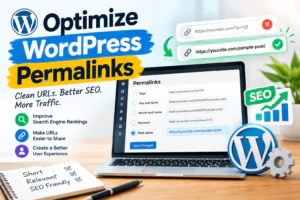
Want to improve your WordPress SEO? Optimizing your permalinks is one of the easiest and most impactful changes you can make. In this complete guide, you’ll learn exactly how to optimize WordPress permalinks for SEO, create clean URL structures that Google loves, and use our free Slug Generator tool to create perfect URLs every time.
📋 What You’ll Learn:
- What WordPress permalinks are and why they matter for SEO
- Best permalink settings for WordPress in 2026
- Step-by-step guide to change permalink structure
- How to create SEO-friendly slugs (with examples)
- Common permalink mistakes to avoid
- How to use our free Slug Generator tool
What Are WordPress Permalinks?
A permalink (permanent link) is the permanent URL of a specific post, page, or other content on your WordPress website. It’s the web address that visitors and search engines use to access your content.
Example:
In the URL https://yoursite.com/optimize-wordpress-permalinks-seo/, the permalink is optimize-wordpress-permalinks-seo.
The part after your domain name is called the slug. This is what you’ll optimize for SEO.
Why Permalinks Matter for SEO
Google uses URLs as a ranking signal. A well-optimized permalink:
- Includes your target keyword: Helps Google understand what your page is about
- Improves click-through rates: Clean, descriptive URLs attract more clicks in search results
- Enhances user experience: Users can understand the URL before clicking
- Makes sharing easier: Clean URLs are easier to share on social media and in emails
- Supports internal linking: Descriptive URLs help with site navigation and link equity distribution
💡 Pro Tip:
According to multiple SEO studies, URLs that include the target keyword rank higher than those without. Optimizing your permalinks is a quick win that can improve your rankings immediately.
Best Permalink Settings for WordPress (2026)
WordPress offers several permalink structure options. Here are the best ones for SEO in 2026:
✅ Recommended: Post Name
Structure: /sample-post/
Best for: Most websites, blogs, and business sites
This is the best permalink structure for SEO. It’s clean, includes your keyword, and is easy to read.
✅ Alternative: Custom Structure (Category + Post Name)
Structure: /category/sample-post/
Best for: Large sites with multiple categories, news sites
This adds your category to the URL, which can help with organization but makes URLs longer.
❌ Avoid These Structures:
- Plain:
?p=123– Terrible for SEO - Day and name:
/2026/09/17/sample-post/– Too long, dates become outdated - Month and name:
/2026/09/sample-post/– Still too long - Numeric:
/archives/123– No SEO value
How to Change WordPress Permalink Structure (Step-by-Step)
Follow these steps to optimize your WordPress permalink settings:
Step 1: Access Permalink Settings
Log in to your WordPress dashboard and navigate to Settings → Permalinks.
📍 Path: WordPress Dashboard → Settings → Permalinks
Step 2: Select “Post Name”
Under “Common Settings,” select the Post name option. This is the SEO-friendly structure we recommend.
✅ Select: Post name (/sample-post/)
Step 3: Save Changes
Click the Save Changes button at the bottom of the page. WordPress will automatically update your permalink structure.
⚠️ Important: If you’re changing permalinks on an existing site, set up 301 redirects from old URLs to new ones to preserve SEO value and avoid 404 errors.
How to Create SEO-Friendly Slugs (With Examples)
Once you’ve set your permalink structure, you need to optimize individual post slugs. Here’s how:
Best Practices for SEO Slugs
- Include your target keyword: Place your primary keyword in the slug
- Keep it short: Aim for 3-5 words maximum (under 60 characters)
- Use hyphens: Separate words with hyphens (-), not underscores (_)
- Lowercase only: Use lowercase letters exclusively
- Remove stop words: Remove “a”, “the”, “and”, “of” unless necessary
- Remove special characters: Strip accents, symbols, and punctuation
Good vs. Bad Slug Examples
✅ Good Slugs:
/optimize-wordpress-permalinks-seo/(clear, includes keyword)/wordpress-seo-checklist/(short, keyword-rich)/how-to-install-wordpress/(matches search intent)/free-wordpress-tools/(descriptive, keyword-focused)
❌ Bad Slugs:
/how-to-optimize-wordpress-permalinks-for-seo-complete-guide-2026/(too long)/post123/(no keywords)/WordPress_SEO_Tips/(underscores instead of hyphens)/10-Tips-For-Optimizing-Your-WordPress-Permalinks-For-SEO/(mixed case, too long)
Use Our Free Slug Generator Tool
🔗 Create Perfect Slugs Instantly
Stop manually creating slugs! Our free Slug Generator tool automatically creates clean, SEO-friendly slugs from any text. Just enter your post title, and it will:
- ✅ Convert to lowercase
- ✅ Remove special characters and accents
- ✅ Replace spaces with hyphens
- ✅ Remove stop words automatically
- ✅ Keep it under optimal length
How to Use the Slug Generator
- Enter your post title (e.g., “How to Optimize WordPress Permalinks for SEO”)
- Click “Generate Slug”
- Copy the generated slug (e.g., “optimize-wordpress-permalinks-seo”)
- Paste it into your WordPress post’s URL slug field
- Publish your post with the optimized permalink!
Common Permalink Mistakes to Avoid
❌ Mistake #1: Changing Permalinks on Existing Sites Without Redirects
If you change permalinks on an existing site, old URLs will return 404 errors, losing all SEO value. Always set up 301 redirects from old URLs to new ones using our Redirect Rules Builder.
❌ Mistake #2: Using Dates in Permalinks
Permalinks like /2026/09/17/post-title/ make content look outdated. Avoid dates unless you’re running a news site where freshness matters.
❌ Mistake #3: Making Slugs Too Long
Long slugs get truncated in search results. Keep them under 60 characters (3-5 words). Use our Slug Generator to keep them optimal.
❌ Mistake #4: Not Including Keywords
Generic slugs like /my-post/ or /post-123/ waste SEO opportunities. Always include your target keyword.
Conclusion
Optimizing your WordPress permalinks is one of the easiest and most impactful SEO changes you can make. By following this guide, you’ll create clean, keyword-rich URLs that Google loves and users trust.
Quick Recap:
- ✅ Use “Post name” permalink structure (
/sample-post/) - ✅ Include your target keyword in every slug
- ✅ Keep slugs short (3-5 words, under 60 characters)
- ✅ Use hyphens to separate words
- ✅ Use our free Slug Generator tool for perfect slugs every time
- ✅ Set up 301 redirects if changing existing permalinks
Ready to optimize your permalinks? Start by changing your permalink settings in WordPress, then use our free Slug Generator to create perfect slugs for all your posts!
🚀 Next Steps:
Want to optimize more aspects of your WordPress SEO? Check out our complete guides: