
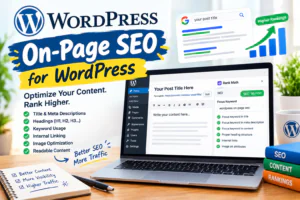
Want to rank higher in Google? On-page SEO is the foundation of every successful WordPress site. In this complete 2026 guide, you’ll learn exactly how to optimize every on-page element for maximum rankings, including titles, meta descriptions, content, images, and internal linking. Plus, discover our free SEO optimization tools to speed up your optimization workflow.
📋 What You’ll Learn:
- What on-page SEO is and why it matters in 2026
- 15 critical on-page SEO factors for WordPress
- Step-by-step optimization checklist
- How to optimize titles and meta descriptions (with tools)
- Content optimization best practices
- Technical on-page SEO elements
- Common on-page SEO mistakes to avoid
What Is On-Page SEO?
On-page SEO (also known as on-site SEO) is the practice of optimizing individual web pages to rank higher in search engines and earn more relevant traffic. Unlike off-page SEO (which focuses on backlinks and external signals), on-page SEO involves optimizing elements you control directly on your website.
💡 Why On-Page SEO Matters in 2026:
- Google uses over 200 ranking factors, and most are on-page elements
- Well-optimized pages rank 2-3x higher than unoptimized content
- On-page SEO improves user experience, not just rankings
- It’s the foundation that makes off-page SEO (backlinks) more effective
15 Critical On-Page SEO Factors for WordPress
Here are the most important on-page SEO elements you need to optimize for every WordPress post or page:
1. Title Tag (Most Important)
Your title tag is the single most important on-page SEO factor. It tells Google and users what your page is about.
Best Practices:
- Include your primary keyword in the first 3-5 words
- Keep it under 60 characters (580 pixels)
- Make it compelling to improve click-through rates
- Add your brand name at the end (optional)
- Use power words: “Complete”, “Ultimate”, “Proven”, “2026”
✅ Good Title Example:
On-Page SEO for WordPress: Complete 2026 Guide (Step-by-Step)
✓ Keyword at beginning ✓ Under 60 chars ✓ Includes year ✓ Clear benefit
❌ Bad Title Example:
Some Thoughts About SEO and How to Maybe Optimize Your WordPress Site
✗ No clear keyword ✗ Too vague ✗ Weak language ✗ No benefit
🔍 Free Tool: Optimize Your Titles
Use our free SERP Preview tool to preview and optimize your title tags before publishing. See exactly how your titles will appear in Google search results!
2. Meta Description
While meta descriptions don’t directly impact rankings, they significantly affect click-through rates (CTR), which is a ranking signal.
Best Practices:
- Keep it between 150-160 characters
- Include your primary keyword (Google bolds matching terms)
- Write a compelling value proposition
- Add a call-to-action: “Learn more”, “Discover how”, “Get started”
- Match search intent (informational, commercial, transactional)
📏 Free Tool: Check Meta Description Length
Use our Meta Length Checker to ensure your meta descriptions are the perfect length. Avoid truncation in search results!
3. URL Structure (Permalinks)
Your URL structure is a direct ranking factor. Clean, keyword-rich URLs help Google understand your content and improve click-through rates.
URL Best Practices:
- Use “Post name” permalink structure in WordPress
- Include your target keyword in the slug
- Keep URLs short (3-5 words, under 60 characters)
- Use hyphens to separate words
- Avoid dates unless running a news site
Pro Tip: Use our free Slug Generator tool to create perfect, SEO-friendly URLs instantly!
4. Content Quality and Depth
Google prioritizes comprehensive, high-quality content that fully satisfies user intent. Thin content rarely ranks well.
Content Length Guidelines:
- Blog posts: 1,000-2,000 words (minimum 800)
- Guides: 2,000-3,000+ words
- Product pages: 300-500 words
- Landing pages: 500-800 words
📝 Free Tool: Check Word Count & Reading Time
Use our Word Count & Reading Time tool to analyze your content length and ensure it meets SEO best practices!
5. Heading Structure (H1-H6)
Proper heading hierarchy helps Google understand your content structure and improves readability.
Heading Best Practices:
- H1: One per page (your post title), include primary keyword
- H2: Main sections, include secondary keywords
- H3: Subsections under H2s
- H4-H6: Further subsections as needed
- Never skip heading levels (don’t go from H2 to H4)
6. Keyword Optimization
Strategic keyword placement signals relevance to Google. However, avoid keyword stuffing—write naturally for humans first.
Where to Include Your Primary Keyword:
- ✅ Title tag (first 3-5 words)
- ✅ Meta description (once)
- ✅ URL slug
- ✅ H1 heading (automatically your title)
- ✅ First 100 words of content
- ✅ 2-3 H2 or H3 subheadings
- ✅ Throughout content naturally (1-2% density)
- ✅ Image alt text (where relevant)
- ✅ Conclusion
7. Image Optimization
Optimized images improve page speed and provide additional ranking opportunities through Google Image Search.
Image Optimization Checklist:
- Compress images (use WebP format, under 100KB)
- Use descriptive file names (e.g.,
on-page-seo-checklist.jpg) - Add alt text with keywords (where relevant)
- Include title and caption (optional but helpful)
- Use lazy loading for faster page speed
8. Internal Linking
Internal links help Google discover and index your content, distribute link equity, and improve user navigation.
Internal Linking Best Practices:
- Link to 3-5 related posts in every article
- Use descriptive anchor text (not “click here”)
- Link to pillar pages and category pages
- Update old posts with links to new content
- Create topic clusters with internal links
9-15. Additional On-Page Factors
- 9. Page Speed: Aim for under 3 seconds load time
- 10. Mobile-Friendliness: Ensure responsive design
- 11. Core Web Vitals: Optimize LCP, FID, CLS
- 12. Schema Markup: Add structured data for rich snippets
- 13. Outbound Links: Link to authoritative sources
- 14. Content Freshness: Update old content regularly
- 15. User Engagement: Reduce bounce rate, increase time on page
Complete On-Page SEO Checklist for WordPress
✅ Pre-Publish Checklist:
Content Optimization:
- ☐ Primary keyword in title (first 3-5 words)
- ☐ Title under 60 characters
- ☐ Meta description 150-160 characters
- ☐ Keyword in URL slug
- ☐ Keyword in first 100 words
- ☐ 2-3 keywords in H2/H3 subheadings
- ☐ Content length 1,000+ words (for blog posts)
- ☐ Internal links to 3-5 related posts
- ☐ Outbound links to authoritative sources
- ☐ Images optimized (compressed, alt text added)
Technical Optimization:
- ☐ Mobile-responsive design
- ☐ Page speed under 3 seconds
- ☐ Schema markup added (if applicable)
- ☐ Proper heading hierarchy (H1-H6)
- ☐ No broken links
- ☐ SSL certificate (HTTPS)
Common On-Page SEO Mistakes to Avoid
❌ Mistake #1: Keyword Stuffing
Don’t force keywords unnaturally. Write for humans first, search engines second. Keyword density should be 1-2% maximum.
❌ Mistake #2: Ignoring Meta Descriptions
Meta descriptions affect CTR, which impacts rankings. Always write compelling, keyword-rich meta descriptions.
❌ Mistake #3: Thin Content
Content under 500 words rarely ranks well. Aim for 1,000-2,000 words for blog posts, 2,000+ for comprehensive guides.
❌ Mistake #4: Skipping Internal Links
Internal links help Google crawl your site and distribute authority. Always link to 3-5 related posts.
Free SEO Tools to Speed Up Optimization
🚀 Our Free WordPress SEO Toolbox
Optimize your on-page SEO faster with our free tools:
Conclusion
On-page SEO is the foundation of every successful WordPress site. By optimizing the 15 critical factors outlined in this guide, you’ll significantly improve your chances of ranking higher in Google and earning more organic traffic.
Key Takeaways:
- ✅ Optimize title tags, meta descriptions, and URLs for every post
- ✅ Create comprehensive content (1,000-2,000+ words)
- ✅ Use proper heading hierarchy (H1-H6)
- ✅ Include keywords naturally throughout content
- ✅ Optimize images with alt text and compression
- ✅ Build internal links to related content
- ✅ Use our free SEO tools to speed up optimization
Ready to optimize your WordPress content? Start by implementing the checklist above, and use our free SEO optimization tools to make the process faster and easier!
📚 Related Guides:
Want to learn more about WordPress SEO? Check out these comprehensive guides: